
An Update on Cable Cars and Muni's Historic Fleet

An Update on Cable Cars and Muni's Historic Fleet
By Erica Kato

Unbeatable views. Unforgettable trips. No experience is more uniquely San Francisco than a ride on a cable car. Cable cars have come to symbolize our great city.  
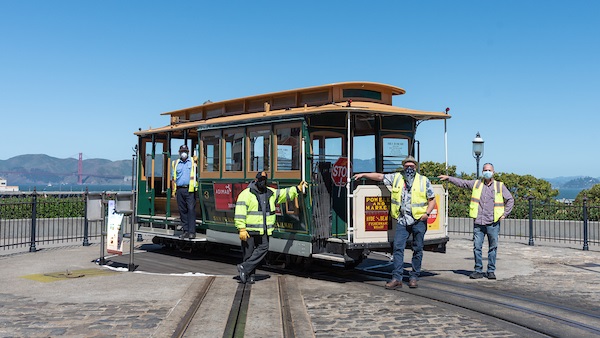
Phot of the Powell/Hyde Cable Car above Fishermans Wharf

The Powell/Hyde Cable Car turnaround at Fisherman's Wharf

Last March, in response to the COVID-19 pandemic, we temporarily halted cable car service as part of the city’s emergency response. This decision was made to best protect our operators and the public. Muni resources were then shifted to a core network to serve our essential workers and accommodate physical distancing on our most utilized lines and to retain access for transit dependent neighborhoods.  

We’re excited to announce that we have a timeline to phase in cable car service, as well as bring back service on our historic F Line fleet. Thanks to the acceleration of the COVID-19 vaccine and a more optimistic outlook for federal funding for public transit, we can craft a path forward. Our plan is to resume F Line service this May, seven days a week. Cable car service will return on the Powell-Hyde line, between Market Street and Fisherman’s Wharf, first this fall — ahead of the holiday season. The cable cars run through the heart of the city and will play a fundamental role in helping the city’s economy recover. What we know is tourism is the main driver of city business, and cable cars are a huge draw to San Francisco. 

In the meantime, we have a lot of work ahead of us before service returns: retraining operators, hiring line inspectors, and preparing our infrastructure to accommodate daily ridership again.   

We are committed to restarting cable car service and are well aware of the tremendous value they have for San Francisco’s history and economy. Please subscribe to our text or e-mail updates for more information on their triumphant return to San Francisco’s hilly streets and most iconic backdrops.  


Published March 03, 2021 at 03:18PM
https://ift.tt/3sRp1iV

Comments

Popular posts from this blog

News from the WHO: The ceasefire in Gaza brings hope, but immense challenges lie ahead to restore the health system

Published on January 19, 2025 View on website

Scooter Permittees Receive Feedback from Students with Disabilities

Scooter Permittees Receive Feedback from Students with Disabilities By Maddy Ruvolo On a recent Monday in Golden Gate Park, 28 students and staff from AccessSFUSD gathered on JFK Drive to test-ride adaptive scooters. The group took turns riding adaptive devices from two scooter companies permitted to operate in the city, Lime and Spin . Adaptive devices are designed to meet the needs of riders with a variety of disabilities and provide additional stability features, such as a seat, a wider base, and an additional wheel. After trying the scooters, the students shared their feedback about a variety of design elements, including the wheels, seat, throttle, basket location, foot plate width, and the ease of getting started.  Adaptive scooter demo in Golden Gate Park Students embraced the opportunity to ride scooters and provide feedback. AccessSFUSD is a community-based program for students 18-22 with disabilities. Located across 11 sites in San Francisco, the program focuses o...

Have Feedback on the COVID-19 Muni Temporary Service Plan?

Have Feedback on the COVID-19 Muni Temporary Service Plan? By Shalon Rogers In March 2020, due to unprecedented constraints on resources brought on by the COVID-19 pandemic, the SFMTA had to make significant transit service reductions. As of January 2021, the agency has been able to restore service to a level where 91% of San Franciscans are within a quarter mile of a transit stop. This is reflected in the SFMTA’s current  COVID-19 Temporary Service Plan .   ' COVID-19 Temporary Service Plan Map The SFMTA is committed to ensuring that our programs and services are  compliant with Title VI of the Civil Rights Act of 1964  and therefore do not have a discriminatory impact based on race, color or national origin. As part of this work, we conducted a Title VI service equity analysis to evaluate the current COVID-19 Temporary Service Plan. The results of this analysis will be presented to the ...